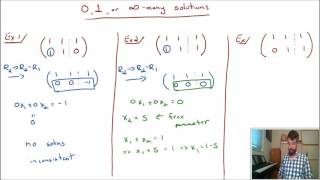
Media Summary: In this problem we determine values of unknown constant k, if any, will give unique solution, no solution In this problem, we determine values of unknown constant k, if any, will give Support the production of this course by joining Wrath of Math to access all my

Zero One Or Infinitely Many Solutions Passing Linear Algebra - Detailed Analysis & Overview

In this problem we determine values of unknown constant k, if any, will give unique solution, no solution In this problem, we determine values of unknown constant k, if any, will give Support the production of this course by joining Wrath of Math to access all my Identify if your Gaussian or Gauss-Jordan Elimination final Chapter 1: Exercise: For which value of a the system has No Solution, exactly Learning Objectives: 1) Apply elementary row operations to reduce matrices to the ideal form 2) Classify the
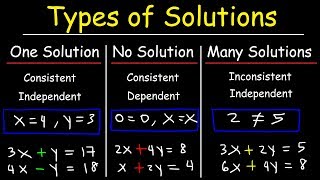
Photo Gallery

One Solution, No Solution, or Infinitely Many Solutions - Consistent & Inconsistent Systems
Zero, One, or Infinitely Many Solutions? [Passing Linear Algebra]
A unique solution, No solution, or Infinitely many solutions | Ax=b
MATH1131 Linear Algebra: Chapter 4 Problem 17
Solving Equations with Zero, One, or Infinitely Many Solutions
Determine which values of k will give, one Solution, no Solution, or infinitely Many Solutions
1 solution, no solution, infinitely many solutions (for linear equations)
Homogenous Linear Systems, Trivial and Nontrivial Solutions | Linear Algebra
1, ∞, or 0 Solutions? (Gaussian and Gauss-Jordan Elimination)
Solving equations with zero, one, or infinitely many solutions
Chapter 1 : Exercise System with NoSol, OneSol, Inf Many Sols
Sponsored
View Detailed Profile
One Solution, No Solution, or Infinitely Many Solutions - Consistent & Inconsistent Systems

One Solution, No Solution, or Infinitely Many Solutions - Consistent & Inconsistent Systems

This

Zero, One, or Infinitely Many Solutions? [Passing Linear Algebra]

Zero, One, or Infinitely Many Solutions? [Passing Linear Algebra]

Solution

A unique solution, No solution, or Infinitely many solutions | Ax=b

A unique solution, No solution, or Infinitely many solutions | Ax=b

A

MATH1131 Linear Algebra: Chapter 4 Problem 17

MATH1131 Linear Algebra: Chapter 4 Problem 17

In this problem we determine values of unknown constant k, if any, will give unique solution, no solution

Solving Equations with Zero, One, or Infinitely Many Solutions

Solving Equations with Zero, One, or Infinitely Many Solutions

How to determine if

Sponsored
Determine which values of k will give, one Solution, no Solution, or infinitely Many Solutions

Determine which values of k will give, one Solution, no Solution, or infinitely Many Solutions

In this problem, we determine values of unknown constant k, if any, will give

1 solution, no solution, infinitely many solutions (for linear equations)

1 solution, no solution, infinitely many solutions (for linear equations)

1 solution, no solution,

Homogenous Linear Systems, Trivial and Nontrivial Solutions | Linear Algebra

Homogenous Linear Systems, Trivial and Nontrivial Solutions | Linear Algebra

Support the production of this course by joining Wrath of Math to access all my

1, ∞, or 0 Solutions? (Gaussian and Gauss-Jordan Elimination)

1, ∞, or 0 Solutions? (Gaussian and Gauss-Jordan Elimination)

Identify if your Gaussian or Gauss-Jordan Elimination final

Solving equations with zero, one, or infinitely many solutions

Solving equations with zero, one, or infinitely many solutions

...

Solving equations with zero, one, or infinitely many solutions

Solving equations with zero, one, or infinitely many solutions

ALEKS math tutorial.

Chapter 1 : Exercise System with NoSol, OneSol, Inf Many Sols

Chapter 1 : Exercise System with NoSol, OneSol, Inf Many Sols

Chapter 1: Exercise: For which value of a the system has No Solution, exactly

Examples with 0, 1, and infinitely many solutions to linear systems

Examples with 0, 1, and infinitely many solutions to linear systems

Learning Objectives: 1) Apply elementary row operations to reduce matrices to the ideal form 2) Classify the